

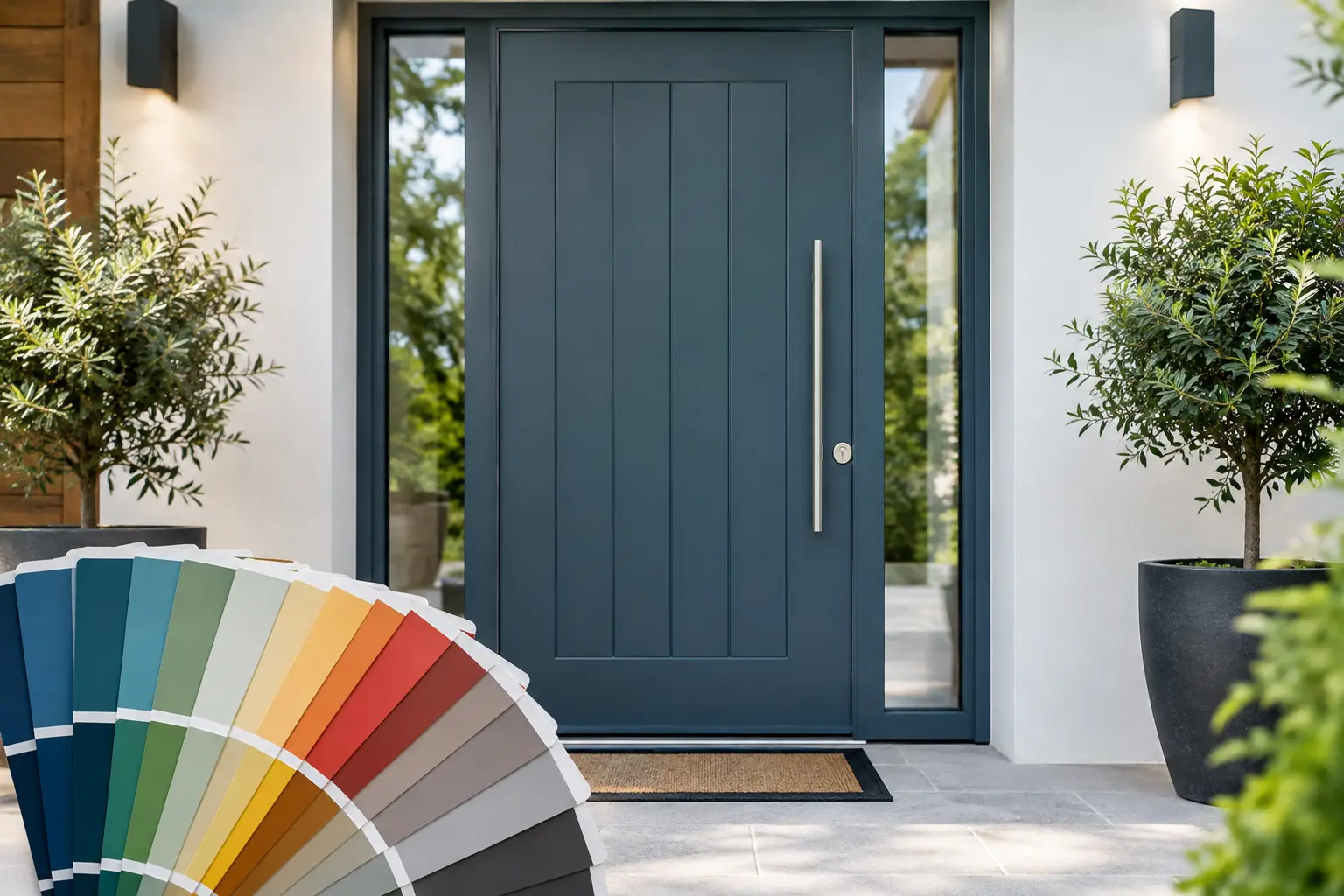
Custom RAL Door Colours for a Refined Entrance
A front door can occupy only a small part of a façade, yet it often determines whether the whole elevation feels considered. Custom RAL door colours give homeowners the freedom to make that first impression precise: a tone that relates to the brickwork, render, window frames, landscaping and character of the property, rather than settling for a standard shade that is merely close enough.
For a made-to-measure aluminium entrance door, colour is not a finishing detail applied at the end of the process. It is part of the design specification. The right choice can make a contemporary extension feel integrated with an older house, bring definition to a pale rendered façade or add a confident focal point to a restrained elevation. The wrong choice can look unexpectedly cold, flat or dominant once it is fitted outside.
Why choose custom RAL door colours?
RAL is a widely recognised colour-reference system used across architecture, construction and manufacturing. It provides a common language for specifying colour accurately, which is particularly useful when an entrance door needs to coordinate with other elements of a project. Instead of relying on descriptions such as ‘dark grey’ or ‘sage green’, a RAL reference identifies a defined shade.
That accuracy matters when details are close together. A door designed to sit beside aluminium windows, beneath a coloured canopy or within a newly rendered porch should feel deliberate. A custom RAL finish allows the door to complement those choices, whether the intention is a quiet tonal relationship or a crisp contrast.
It also gives more scope for individuality. Deep blue-black, olive green and muted grey remain popular for good reason, but they are not the only routes to a refined entrance. Warm off-whites can soften contemporary architecture; clay, bronze and earthy red tones can sit beautifully against buff brick; and a carefully selected bright colour can bring real character to a simple frontage. Bespoke need not mean conspicuous. Often, the most successful colour is one that looks entirely at home.
Start with the architecture, not a colour chart
A RAL chart presents many possibilities, but choosing from it in isolation can be misleading. Begin with the fixed materials around the entrance: brick, stone, render, roof tiles, window frames, paving and any metalwork. Their undertones are more influential than they first appear.
Red brick may contain brown, orange, pink or purple notes. White render can lean cool blue-grey, warm cream or neutral. Even grey can vary widely. A blue-based charcoal beside a warm sandstone wall may look sharper than intended, while a brown-based grey may create a more settled result. Viewing samples next to the actual building materials is far more reliable than viewing them against a white screen or in a showroom alone.
The age and style of the house should guide the level of contrast too. A clean-lined aluminium door in a dark architectural shade can give a modern extension definition without trying to imitate period joinery. Conversely, a traditional property may benefit from a softened, heritage-inspired tone, particularly where the door has more classical detailing or glazed panels.
There is no requirement to match every external element. In fact, matching a front door exactly to window frames can sometimes make an entrance lose its presence. A related shade, or a contrast drawn from the roof, brick or planting scheme, can create a more balanced composition.
Consider the view from the street and from inside
Most colour decisions are made from the pavement, but the inside view matters as well. The internal face of an entrance door is part of the hallway, where wall colour, flooring and natural light can be very different. A dual-colour specification can be a considered solution when the exterior needs a strong architectural finish and the interior calls for something quieter.
This is especially useful in open-plan homes, where the entrance is visible from a living space or kitchen. A pale internal finish can keep a hallway light, while a richer external colour gives the property a confident street presence. The exact options depend on the chosen door design and specification, so this should be agreed early in the design process.
Light changes how a RAL colour looks
A RAL reference is fixed, but its appearance is not. Natural light, surrounding materials, orientation and weather all affect what the eye sees. A colour that appears nearly black on a north-facing elevation may reveal blue, green or brown undertones in direct afternoon sun. Similarly, a light grey can look almost white against dark brick but noticeably darker beside pale render.
This is why a physical sample is essential before final approval. View it outside, against the proposed surroundings, at several points during the day. Check it in full sun, shade and the flatter light of an overcast afternoon. British weather gives an entrance door plenty of different conditions, and the chosen colour should feel right in more than one of them.
Screens are useful for early inspiration, but they cannot show colour faithfully. Display settings, photography, ambient light and image processing all alter the result. Printed swatches are helpful for narrowing a choice, yet a coated sample remains the better final reference.
Think about sheen and texture as well as shade
Colour is only one part of a finish. The sheen level changes how strongly a door reflects light and how much the surface emphasises its form. A more matt finish can feel understated and architectural, while a subtle satin sheen can bring definition to profiling and detailing. The best choice depends on the building and the desired effect.
Textured finishes can also influence the perceived depth of a colour. Fine texture may make a dark shade appear softer and more forgiving in daily use, whereas a smoother finish delivers a cleaner, more contemporary look. Neither is automatically superior. A crisp modern frontage may suit a smooth finish, while a textured coating can sit naturally alongside traditional brick or stone.
It is worth discussing practical expectations honestly. Very dark colours can show dust, water spotting and pollen more readily than mid-tones, particularly in exposed or coastal locations. Very pale shades may reveal grime around handles and letterplates. Aluminium is valued for its low-maintenance qualities, but every exterior finish benefits from occasional gentle cleaning to retain its appearance.
Coordinate the complete door specification
A bespoke door is a composition of elements, not simply a coloured slab. Handle finishes, glazing, side panels, house numbers, lighting and threshold details all contribute to the final result. A black handle against a warm grey door creates a different feel from brushed stainless steel or a bronze-toned option. The aim is not to make every component identical, but to make them belong together.
Glazing deserves particular attention. Obscure, reeded and decorative glass can alter the perceived lightness of the entrance, while clear glass creates a stronger connection with the hall beyond. On a dark door, a generous glazed panel can prevent the design from feeling too heavy. On a pale door, a darker frame or handle can add useful definition.
Side panels and double-door arrangements require the same discipline. Where a door and side panel are designed as one installation, their proportions and finish should be considered together. This is one of the advantages of precision-manufactured aluminium: the system can be configured around the opening rather than forcing the property to accept standard dimensions.
Colour should never compromise performance
An exceptional entrance needs more than visual impact. The colour and finish should sit within a door specification that delivers security, thermal efficiency and weather resistance appropriate to the home. A premium aluminium entrance door can combine a bespoke RAL finish with reinforced construction, multi-point locking and PAS24-tested security, so the design-led choice does not come at the expense of peace of mind.
Thermal performance matters too, particularly on older properties where a replacement door may address draughts and heat loss at the entrance. Specifying a door with strong insulation and carefully engineered seals supports comfort throughout the year. Colour may be the feature everyone notices first, but the engineering behind it is what makes the investment feel worthwhile every day.
For homeowners and trade professionals, it is sensible to confirm the available coating options for the chosen door style, including any limitations around special finishes, texture, dual colours and matching adjacent systems. A RAL reference creates clarity, but it does not guarantee that every material will present the colour in exactly the same way. Aluminium, uPVC, painted timber and masonry all reflect light differently. Where an exact visual relationship is essential, compare finished samples rather than relying on the number alone.
A considered finish, made for your property
The best custom RAL door colour is rarely the one that looks most dramatic on a chart. It is the colour that makes the architecture feel more resolved, works in the changing light around the property and continues to look right after the novelty of a new installation has passed.
Rhino Aluminium precision manufactures bespoke entrance doors in Britain, allowing colour, configuration, glazing and hardware to be specified around the property rather than selected from a limited off-the-shelf range. Take time with the samples, assess them in their intended setting and choose the finish that gives your entrance a sense of lasting purpose.