

What Aluminium Door U-Values Really Tell You
A front door is one of the smallest areas of a home’s external envelope, yet it sits at a point where warmth, weather and security all meet. Aluminium door U-values give a clear indication of how effectively that entrance resists heat loss. For homeowners comparing premium doors, they are a useful figure – but only when read in the right context.
A low U-value is desirable, but it should not be treated as a standalone measure of quality. The construction of the frame, the size and specification of glazing, the threshold, the door’s fit and the way the value has been calculated all influence real-world performance. A well-designed aluminium entrance door should deliver thermal efficiency without asking you to compromise on proportion, security or refined design.
What are aluminium door U-values?
A U-value measures the rate at which heat passes through a building element. It is expressed in watts per square metre Kelvin, or W/m²K. Put simply, it shows how much heat is lost through a square metre of material when there is a one-degree difference between indoors and outdoors.
The lower the number, the better the insulation. A door with a U-value of 1.0 W/m²K will retain heat more effectively than one rated at 1.4 W/m²K, assuming both figures are measured on the same basis.
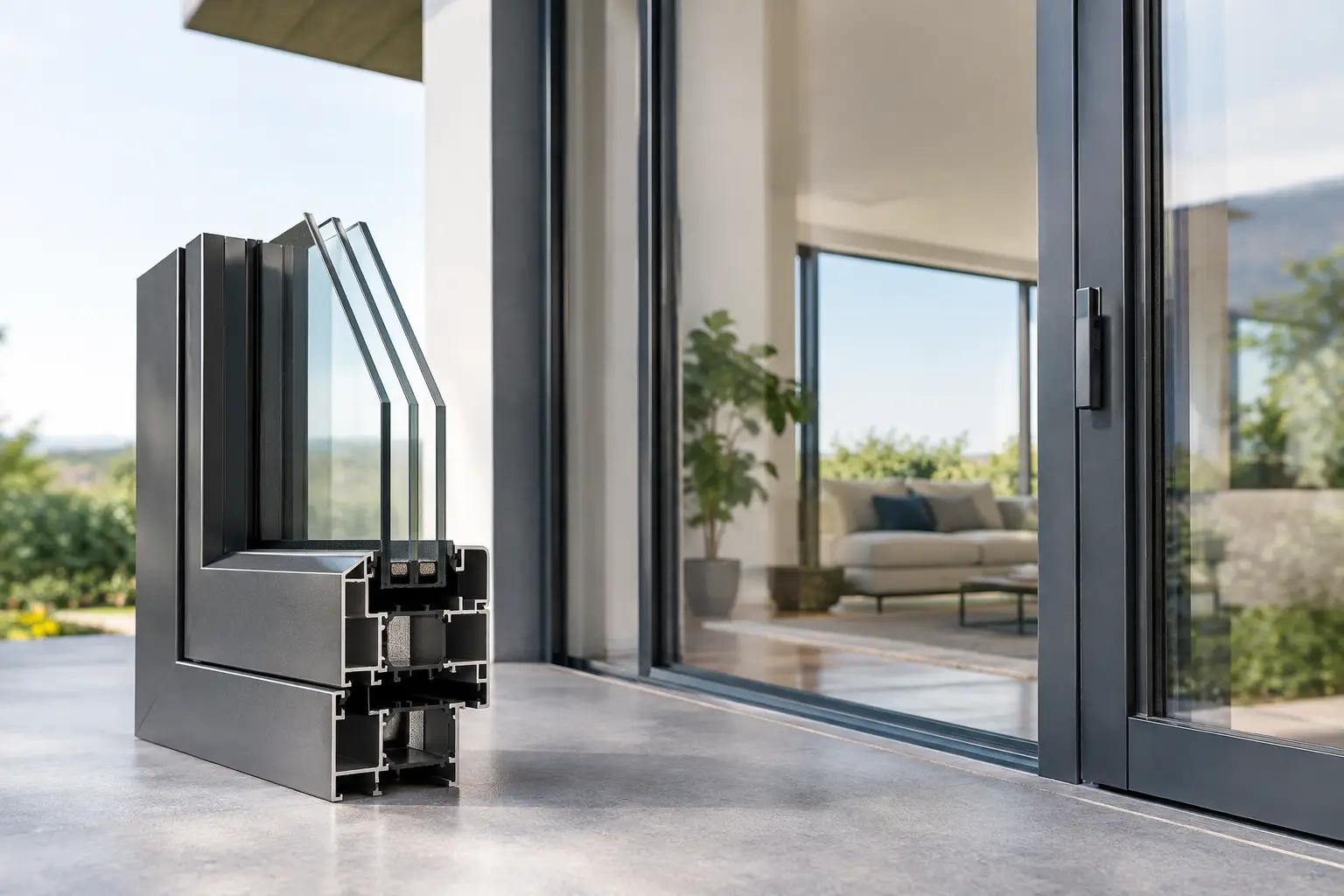
This distinction matters because aluminium is naturally conductive. Left untreated, it can allow heat to travel through the profile more readily than insulated materials. Modern high-performance aluminium doors overcome this with a thermal break – an insulating section within the profile that separates the inside and outside aluminium sections. It is this engineered construction that allows aluminium to support excellent thermal performance while retaining the slim sightlines, strength and design freedom for which it is valued.
Why the whole-door U-value matters most
When comparing specifications, first establish what has actually been tested or calculated. A panel-only value can look impressive, but it does not represent the performance of the complete entrance assembly.
The most meaningful figure is the whole-door U-value, sometimes called the door-set U-value. This takes account of the door leaf, frame, hinges, seals, threshold and any glazed areas. If your design includes side panels, fanlights or extensive decorative glazing, these should also be considered as part of the wider entrance arrangement.
A solid door panel and an insulated aluminium frame do not perform in isolation. Heat can be lost at the edges of the door, through glazing, around the threshold and wherever components meet. Precision manufacturing and careful installation therefore matter just as much as the headline figure.
For a made-to-measure entrance, the final U-value can vary with its size and specification. A broad double-door arrangement with glazed side panels will not behave in exactly the same way as a compact, solid single door. That is not a reason to avoid a more ambitious design. It is a reason to ask for performance information that reflects the door you are actually choosing.
Centre-panel values versus installed performance
Some materials have their own thermal ratings. You may see figures quoted for an insulated panel, a glazing unit or a profile section. These can be useful technical details, but they are not interchangeable with a whole-door U-value.
A centre-panel value measures performance away from edges and joints, where heat loss is often lowest. A complete door calculation accounts for the less forgiving areas: frame interfaces, panel edges, locks, hinges and thresholds. For homeowners, the latter is the figure that better reflects how the entrance will perform once fitted to the property.
What affects the U-value of an aluminium entrance door?
The door’s insulated core is a major factor, particularly on solid contemporary designs. So too is the depth and engineering of the aluminium profile, including the quality of its thermal break. Premium systems are designed to interrupt the direct transfer of heat through the metal while maintaining the strength needed for secure, large-format doors.
Glazing also has a direct effect. A door with a narrow glazed aperture can remain highly efficient, while a design featuring larger glazed areas will depend on the glass specification, spacer technology and the proportion of glass to insulated panel. Decorative glass should be selected for more than appearance alone. Privacy, daylight, safety and thermal performance all need to work together.
The threshold deserves particular attention. It must provide a practical transition between inside and outside, resist driving rain and support accessible entry where required, yet it is also a potential weak point in the thermal envelope. A properly designed and installed threshold helps limit draughts without making the doorway awkward to use.
Finally, dimensions matter. Larger doors and more complex configurations have longer frame perimeters and more junctions. Their performance can still be excellent, but quoted values should be based on the intended size rather than a conveniently small reference door.
How low should a front door U-value be?
There is no single answer that suits every home. Building Regulations set minimum thermal standards for external doors in relevant circumstances, but an entrance door is a long-term investment in comfort, appearance and property performance. Choosing only to meet a minimum requirement may not reflect the standard of a well-insulated renovation, extension or self-build.
For many homeowners, a whole-door U-value of around 1.0 W/m²K represents a strong level of performance for a premium aluminium entrance door. It can make particular sense where the rest of the project includes upgraded insulation, efficient glazing and considered airtightness measures.
However, lower is not automatically better if the comparison ignores the design brief. A very low value quoted for a small solid door may be less relevant than a slightly higher, honestly calculated figure for the larger glazed entrance you want. The right specification balances thermal performance with the amount of daylight, the architectural character of the façade, security requirements and everyday use.
U-values, draughts and everyday comfort
A good U-value helps reduce conductive heat loss, but it is not the same as airtightness. A door can have an impressive thermal rating and still feel uncomfortable if it is poorly adjusted or installed with gaps around the frame.
Weather seals, multipoint locking and accurate fabrication all help create consistent compression around the opening when the door is closed. This limits unwanted air movement and improves the sense of comfort in hallways and entrance spaces, which are often the first rooms to feel cold on a winter morning.
Installation is equally important. The gap between frame and wall must be correctly packed, insulated and sealed for the building construction. This is particularly relevant in older properties, where uneven reveals and non-standard openings are common. A made-to-measure door gives the installer a sound starting point, but site preparation remains essential.
Thermal efficiency without losing design freedom
Aluminium is often selected because it can create a more distinctive entrance than a standard replacement door. It supports broad panels, crisp detailing, concealed or statement hardware, integrated glazing and a wide choice of colours and finishes. The question is not whether design has to give way to performance. It is whether the door has been engineered to deliver both.
A timber-effect or oxide-effect finish, for example, can bring warmth and character to the exterior without the ongoing maintenance associated with natural timber or ageing steel. Contemporary flush panels can suit a modern extension, while traditional layouts and glazed configurations can be tailored for period-influenced homes. Each choice should be specified alongside its thermal implications, especially where glass area or side panels are involved.
Rhino Aluminium manufactures bespoke entrance doors in Britain with whole-door U-values available from 1.0 W/m²K. That performance sits alongside reinforced construction, multi-point locking and PAS24-tested security, because an entrance should protect the home as effectively as it enhances it.
Questions to ask before you compare quotes
When reviewing door quotations, ask whether the stated U-value is for the full door set or only the panel. Confirm the size and configuration used for the calculation, particularly if your design includes glass, side panels or double doors.
It is also sensible to ask how the frame is thermally broken, what glazing specification is included, and whether the threshold and seals form part of the stated performance. For renovation projects, discuss the wall construction and proposed installation method early. This helps avoid a situation where a carefully specified door is fitted into an opening that has not been prepared to the same standard.
Do not separate thermal efficiency from security and weather resistance. A front door must perform on every ordinary day – through cold snaps, wind-driven rain, school-run rushes and late-night returns. Strong locking, stable construction, durable finishes and dependable sealing are all part of the value you are buying.
The best aluminium entrance door is not simply the one with the lowest number on a specification sheet. It is the one precisely made for your opening, honestly rated as a complete assembly and designed to make coming home feel warmer, quieter and more secure.