

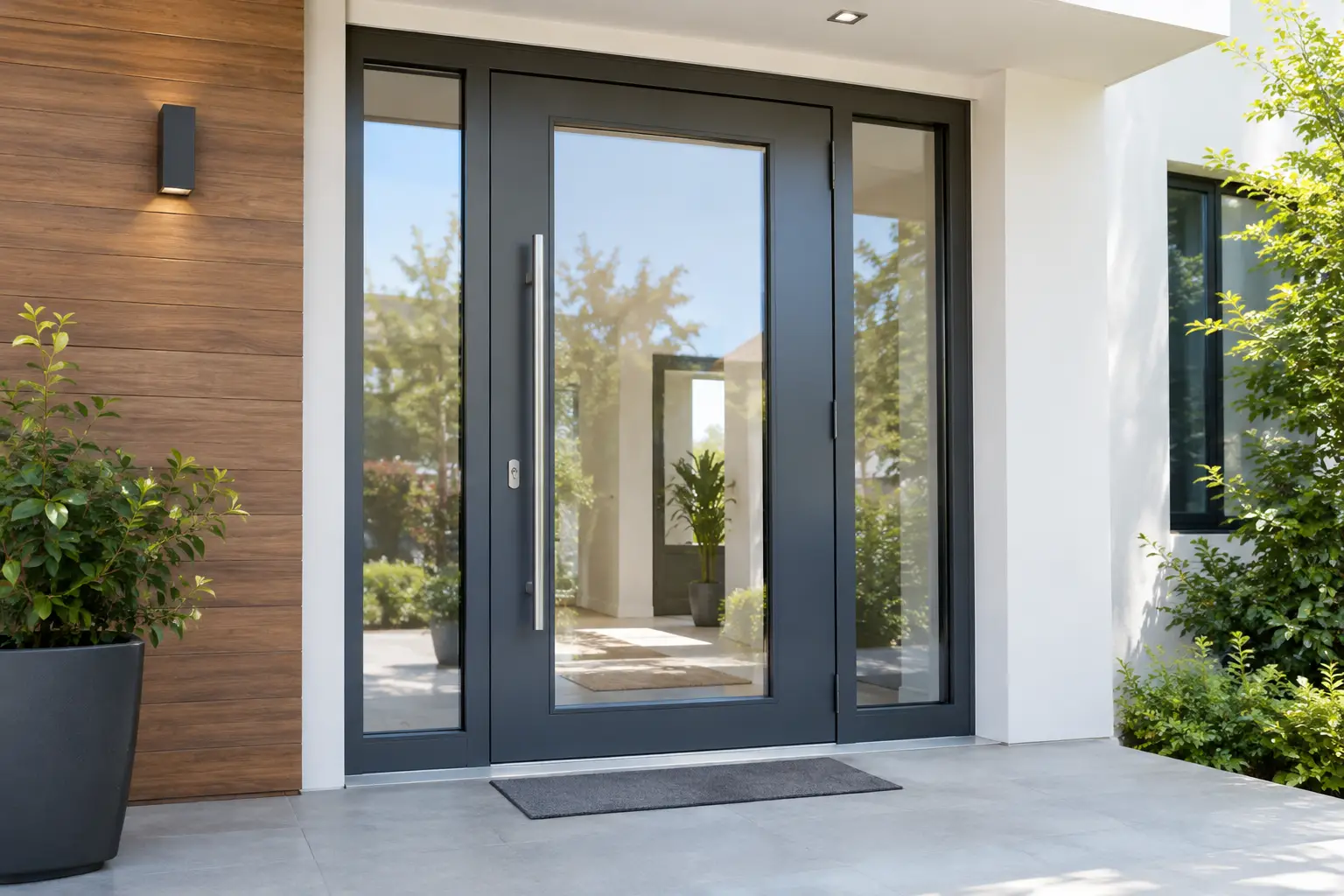
Choosing Aluminium Doors for a Better Entrance
The front door is often the smallest elevation of a home, yet it carries an outsized share of its character. Choosing aluminium doors is therefore about more than replacing a tired entrance. It is an opportunity to set the architectural tone, improve daily comfort and invest in security that feels as considered as the design.
For a period property, a new-build or a carefully planned extension, the strongest choice begins with a clear brief: how should the entrance look, how must it perform, and what does the surrounding property ask of it? Aluminium gives homeowners unusual freedom to answer all three questions without accepting a standard-sized, standard-finish solution.
Start with the character of the property
A front door should have presence, but it should not feel detached from the rest of the house. Look first at the building’s proportions, brickwork, window frames, roofline and approach from the street. A tall entrance with sidelights may suit a broad contemporary façade, while a solid single leaf can bring welcome definition to a narrower opening.
Aluminium is particularly effective where crisp lines and large-scale detailing are wanted. Its inherent strength allows for slim, precise sections and substantial door leaves without the bulk that can affect other materials. That makes it well suited to contemporary architecture, but it should not be seen as a contemporary-only material.
For more traditional homes, panelled designs, restrained glazing and carefully selected hardware can create an entrance with appropriate heritage character. Timber-effect finishes offer the warmth and grain associated with wood while avoiding the regular painting, swelling and weathering concerns that can accompany a natural timber door. Oxide-effect finishes provide another distinctive option, bringing the visual depth of aged metal to homes with industrial, rural or architect-led character.
The objective is not to make the door disappear. It is to make it feel inevitable – a refined part of the property rather than an afterthought.
Choosing aluminium doors with the right configuration
The opening itself will guide many decisions. A made-to-measure door can be designed around the available space, rather than forcing the space to accept a limited product range. This is especially valuable in older homes, where openings are rarely uniform, and in extensions or self-builds where the entrance can be planned as part of the wider design.
A single entrance door is often the right answer for compact porches and conventional openings. Where the façade has more width, a side panel can introduce daylight and visual balance without making the entrance impractical. Glazed side panels can be clear, obscured or decorative depending on the desired level of privacy.
Double entrance doors make a confident statement and offer useful flexibility when moving furniture, welcoming guests or connecting a home to a generous entrance hall. They do, however, need careful proportioning. On a modest frontage, an oversized double-door arrangement can dominate the elevation. A bespoke design allows the active and passive leaves, glazing and surrounding panels to be resolved in a way that feels balanced.
Consider how the door will be used every day. Think about the swing direction, clearance in the hallway, the position of a coat stand or radiator, and whether a canopy provides shelter when arriving with shopping or children. Good entrance design is as practical at 7am in the rain as it is impressive from the pavement.
Treat security as part of the specification
A premium entrance should look composed, but its most valuable qualities are often out of sight. Aluminium doors should be specified with a reinforced construction, dependable hinges, high-quality cylinder protection and a multi-point locking system that secures the leaf at several points around the frame.
Independent testing provides useful reassurance. PAS24 is a recognised standard for enhanced security performance in doors and windows, while Secured by Design accreditation identifies products that meet police-backed security principles. These credentials are not simply technical labels. They give homeowners and trade professionals confidence that design-led detailing has been supported by meaningful testing.
Security is also influenced by the smaller choices. Glazing should be suited to its location and purpose, hardware should feel substantial and operate cleanly, and the letterplate or access controls should be considered as part of the complete assembly. If privacy is a concern, obscure or decorative glass may be a better choice than relying on blinds or films added later.
There is a trade-off to manage here. Highly decorative glazing, multiple accessories and elaborate handle arrangements can add visual interest, but a simpler composition often delivers the most enduring appearance. Choose details that earn their place through function as well as style.
Check thermal performance and weather resistance
A front door is a barrier between the conditioned interior and the British weather. Its thermal performance affects the comfort of the entrance hall, potential heat loss and the risk of cold surfaces around the frame. Look beyond broad claims and ask for a stated U-value for the door configuration being considered. Values from 1.0 W/m²K can provide excellent thermal efficiency when combined with correct fabrication and installation.
The door leaf alone does not tell the whole story. Frame design, thermal breaks, seals, thresholds and glazed areas all influence the finished result. Large glazed panels can bring beautiful daylight into a dark hallway, but glass selection matters. The right specification can retain light while supporting insulation, privacy and security.
Weather performance deserves equal attention. Driving rain, wind exposure and repeated temperature changes test every seal and joint. A well-engineered aluminium door is designed to remain stable and weather resistant over time, but performance depends on precise manufacturing and correct fitting. This is why it is worth selecting a supplier that understands the complete entrance system rather than viewing the door as an isolated panel.
Make colour and finish work harder
Colour is one of the most immediate decisions, yet it should be made after the form and glazing have been established. A strong colour can sharpen the geometry of a minimalist door, while a quieter tone may allow distinctive brickwork or stone to take the lead.
Anthracite and black remain popular for good reason, particularly alongside contemporary windows. But they are not the only route to a refined result. Softer greys, heritage-inspired shades, muted greens and bespoke RAL colours can connect an entrance to its setting with greater subtlety. Look at samples outdoors, ideally beside the existing façade, because daylight changes colour more than a screen ever can.
Finish has a practical role as well. A powder-coated aluminium surface is low maintenance, requiring routine cleaning rather than the regular repainting associated with timber. Timber-effect Naturale finishes and oxide effects add visual texture where a flat colour would feel too clinical. Their appeal lies in combining expressive surface character with the durability and stability of aluminium.
Hardware should complete the composition. A long pull bar can suit a tall contemporary slab, while a more traditional handle may bring the right scale to a panelled door. Match or contrast hardware deliberately with the door finish, external lighting and house numbers. These are small decisions, but they are encountered every time someone arrives.
Value British manufacture and a clear process
A bespoke entrance is an investment, so the quality of the process matters as much as the finished image. Accurate surveys, detailed drawings or specifications, realistic lead times and clear advice on options reduce the risk of compromise later. For trade customers, consistency of fabrication and reliable delivery are equally central to a successful installation programme.
British in-house manufacture offers useful advantages: closer oversight of quality, exact-to-specification fabrication and direct access to the people who understand the product. Rhino Aluminium manufactures bespoke aluminium entrance doors in Broadstairs, Kent, combining carefully engineered performance with an extensive choice of styles, finishes and configurations.
Before committing, ask to see how the selected design will be proportioned for your opening, what performance credentials apply to the proposed specification, and what is included in the quotation. Establish whether handles, glazing, sidelights, thresholds and installation are covered. The lowest initial figure can prove poor value if key elements are treated as extras or if the product is not genuinely made for the property.
A well-chosen aluminium door does more than close an opening. It gives the home a clearer identity, makes every arrival feel more considered, and continues to perform quietly through the years that follow.