

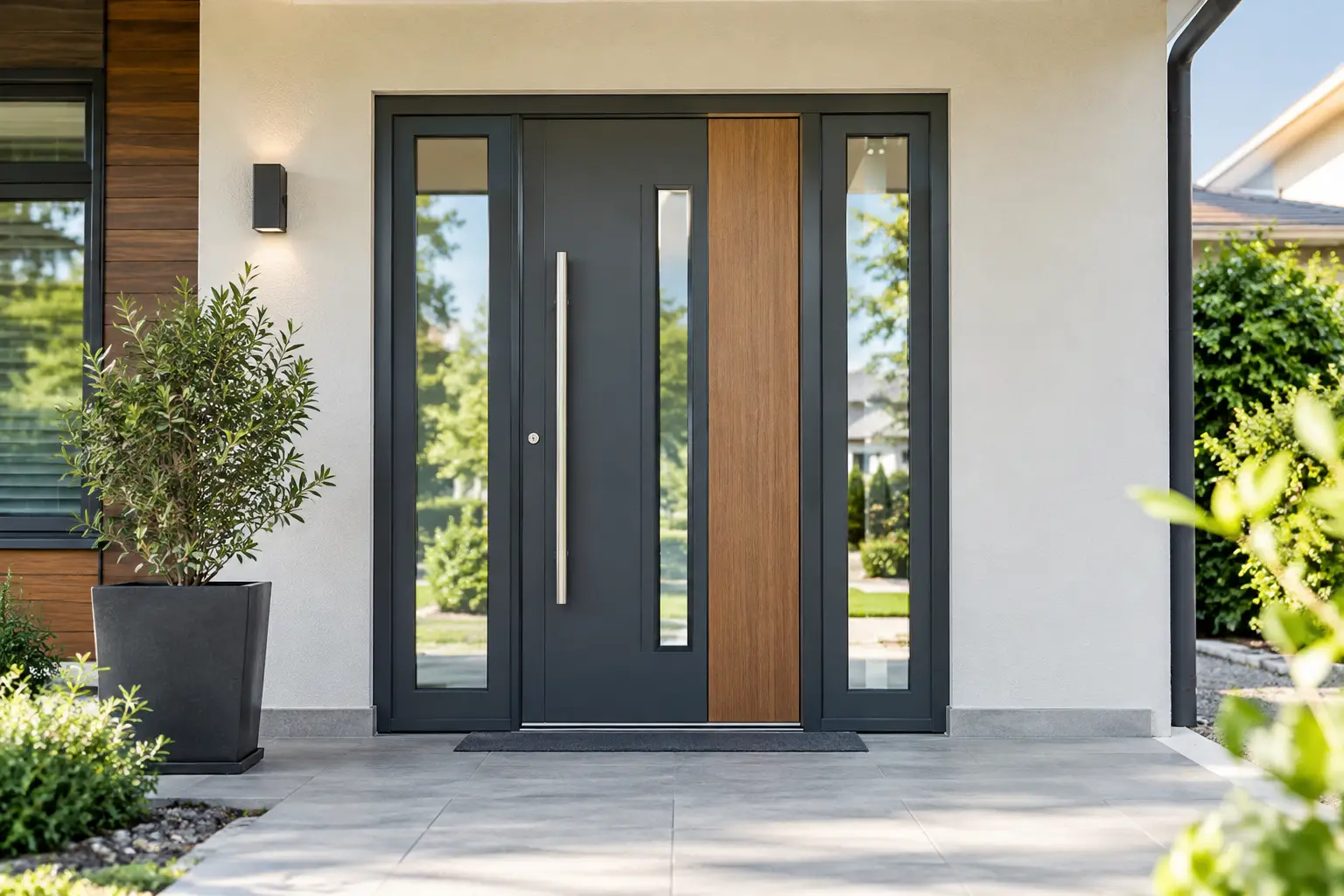
Dual Colour Aluminium Front Doors for Every Home
A front door is viewed from two very different places: from the pavement, where it defines the character of the property, and from the hallway, where it must belong with the interior. Dual colour aluminium front doors resolve that tension by allowing the external and internal faces to be specified independently. It is a considered option for homeowners who want a confident architectural statement outside without introducing an unsuitable colour into the home.
For a contemporary extension, period renovation or new-build project, this flexibility can make the entrance feel designed rather than simply fitted. The right combination takes account of brickwork, render, window frames, flooring, joinery and natural light – while retaining the engineered performance expected from a premium aluminium door.
Why choose dual colour aluminium front doors?
A single-colour door can be highly effective, particularly where the property has a clear, restrained palette. However, the outside of a house often asks for a deeper or more expressive finish than the hallway can comfortably accommodate. Anthracite grey, black, deep blue and distinctive oxide effects can give an elevation real definition, yet a dark internal face may make a narrow or low-lit entrance feel more enclosed.
With a dual colour specification, the exterior can complement the architectural fabric of the building while the interior is selected to work with the rooms beyond it. A dark graphite outside paired with a soft grey, white or warm neutral internally is a popular example. The contrast is purposeful: one side creates kerb appeal, the other supports a lighter, calmer interior scheme.
This is not merely a decorative upgrade. An entrance door is a substantial visual plane, often seen alongside side panels, glazing and external lighting. Treating each face as part of its own setting gives greater control over the finished result, particularly in open-plan homes where the hallway is visible from several rooms.
Start with the exterior architecture
The external colour should first respond to the permanent features of the property. Consider the tone and texture of brick, stone, render, roof tiles, window frames and boundary details before looking at paint charts in isolation. A colour that appears elegant on a small swatch can read quite differently across a full-height aluminium door in direct sunlight.
Dark finishes give strong definition and suit contemporary elevations, pale render and crisp masonry detailing. Black can be particularly effective with slim glazing and modern cladding, while a carefully selected grey offers a softer alternative where pure black would feel too severe. On traditional properties, heritage-inspired greens, blues and muted tones can provide character without becoming overly decorative.
Timber-effect and oxide-effect finishes offer another route. A timber-effect aluminium door can introduce warmth against modern brickwork or render, without the routine refinishing associated with natural timber. Oxide-effect finishes bring depth and a distinctive aged-metal character, working especially well where the architecture includes steel, exposed brick or industrial-inspired details.
The external face does not need to match every window exactly. In fact, a slight contrast can add hierarchy, allowing the entrance to stand apart as the focal point. What matters is that the undertones work together. Cool grey windows and a warm brown door may compete, whereas a purposeful contrast between black frames and a natural timber-effect entrance can feel composed and inviting.
Do not overlook frames, side panels and thresholds
The door leaf is only one part of the entrance composition. If your design includes side panels, an over-panel, double doors or glazed sections, decide whether these elements should match the door, match the windows or provide a quieter frame around the main feature.
A full-height glazed side panel, for example, may benefit from an exterior frame colour that relates to the door and an internal colour that works with hallway walls or joinery. Threshold details should also be considered early, particularly where internal flooring runs directly towards the entrance. Precision in these smaller transitions is what gives a bespoke installation its finished appearance.
Make the internal colour work harder
Inside, the best choice is usually the one that supports light and continuity. White and lighter neutral finishes are practical in compact hallways, helping the door frame recede into the surrounding architecture. Soft greys can link with contemporary décor while remaining less stark than white.
That said, the internal face need not disappear. A deep colour can look exceptional in a generous hall with good daylight, especially when repeated in stair spindles, internal steelwork or fitted joinery. The key question is whether the shade is part of a wider scheme. If it is the only dark element in the space, it can appear heavy once the door is closed.
Think, too, about the light entering through the door. Frosted, patterned or decorative glazing changes both privacy and the quality of daylight in the hall. A darker internal colour paired with generous glazing may feel balanced; the same finish on a solid door in a shaded porch may not. Viewing larger finish samples and considering the orientation of the entrance can prevent costly second thoughts.
Performance should not be secondary to colour
The advantage of aluminium is that design freedom does not have to come at the expense of strength, thermal efficiency or weather resistance. A well-specified aluminium entrance door is precision manufactured around reinforced sections, durable finishes and secure locking components designed for daily use.
For homeowners, security credentials deserve close attention. Look for a door system engineered with multi-point locking, reinforced construction and PAS24-tested security where specified. Secured by Design accreditation provides further reassurance that the product has been assessed against recognised police-preferred standards. The final specification matters, as performance can vary according to the configuration, glazing and hardware selected.
Thermal performance is equally relevant. Modern aluminium entrance doors use thermal breaks to reduce heat transfer through the profile, helping create a warmer internal surface and improve overall energy efficiency. U-values from 1.0 W/m²K are available within high-performance door ranges, but always compare like for like: the quoted figure should relate to the complete door arrangement, not simply a component in isolation.
Weather performance is particularly valuable on exposed South East coastal sites and entrances without a deep canopy. Correct fabrication, seals, drainage and installation all contribute to keeping out wind-driven rain and draughts. A premium door deserves equal care in surveying and fitting; even the finest design cannot compensate for poor installation.
How to specify the right combination
Begin with the view from the road, then move through the threshold into the hall. Photograph the elevation in daylight, take samples of brick or render into account, and identify the colours already fixed by windows, roofline and paving. Next, assess the interior from the entrance looking in, rather than choosing solely from a mood board.
It helps to make decisions in this order: door style, exterior finish, internal finish, glazing, handle and hardware. The style determines the visual language, whether that is a flush contemporary slab, a traditional panelled design, a timber-effect surface or an oxide-inspired statement. Colour can then enhance the design rather than attempting to rescue an unsuitable one.
Handles and letterplates should be specified as part of the same composition. A long stainless steel pull handle can reinforce a contemporary glazed door, while black hardware may give a stronger, more graphic finish. Where an external letterplate is unnecessary, removing it can preserve the clean, uninterrupted face of a modern design. Practical requirements still come first, of course, including postal access, accessibility and the way the door will be used each day.
For larger entrances, ask how the colour treatment will continue across double doors and adjacent panels. Consistency matters, but symmetry is not always essential. A confident asymmetrical glazed panel can create a more distinctive entrance, provided the proportions and sightlines have been properly considered.
Bespoke manufacture gives you greater control
Standard door sizes and fixed colour choices can force compromises, especially in older properties with unusual openings or self-build projects with detailed architectural plans. Made-to-measure manufacture allows the door, frame, panels and glazing to be developed as one complete entrance rather than assembled from disconnected choices.
Rhino Aluminium manufactures bespoke entrance doors in Britain, combining refined design options with exact-to-specification fabrication. This approach is particularly valuable when matching a distinctive exterior finish to a quieter internal palette, or when a wider glazed arrangement requires careful proportions and performance planning.
Dual colour aluminium front doors are most successful when both faces have a clear purpose. Choose the exterior for the architecture you want to present, and the interior for the home you want to live in. That small act of specification can turn the threshold into a feature that feels right from every angle.